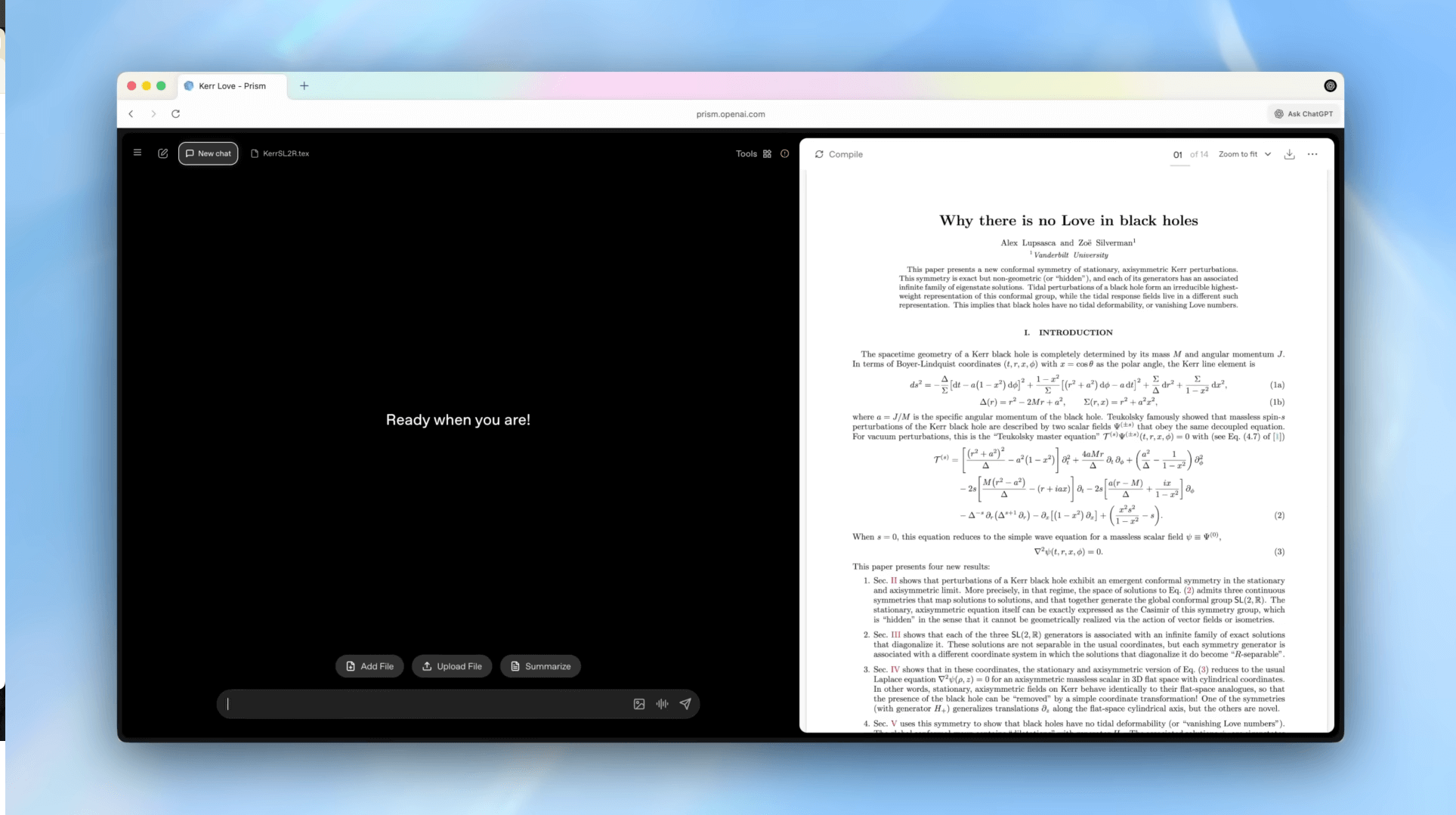
Scientists have already been researching and writing scientific papers with GPT-5.2 following a recent update that saw major improvements to the model. OpenAI’s Prism takes that work a step further.
Prism is an AI-assisted system that pairs the reasoning capabilities of GPT-5.2 with LaTeX-native typesetting support. Researchers can draft, proofread, and edit technical papers while using AI tools to collaborate and create diagrams.
OpenAI brings these workflows into a single AI-native workspace with Prism.
What Can Scientists Do With Prism?
Prism is a workspace that supports scientists from early drafts through final edits with LaTeX-native tools and integrated technical analysis.
The platform uses LaTeX typesetting tools as its foundation, but supports research beyond the scope of traditional document preparation.
Scientists can use Prism to:
✔️ Collaborate: Researchers can share documents, track changes, and communicate with an unlimited number of team members without disrupting formulas or citations.
✔️ Review literature: It can help discover relevant sources and organize references while drafting.
✔️ Scale workflows: Prism is designed for long-term research projects, supporting documentation and analysis through different stages of experiments and studies.
✔️ Manage complex workflows: AI-powered tools accommodate tables, charts, and different document structures from discovery to late-stage edits.
✔️ Contribute remotely: A cloud-based workspace provides flexibility around where researchers can write, edit, and research.
✔️ Save time: Seamless integration of ChatGPT with LaTeX cuts down on manual input while writing, clarifying reasoning, and iterating.
✔️ Stay consistent: Prism helps researchers maintain consistency across terminology and structure from first to final draft. It also makes it easier to follow how discussions and conclusions change over the course of a study.
Prism can be used through a ChatGPT personal account, with business and education accounts planned for the future.
Why OpenAI Is Developing Research Tools
OpenAI’s introduction of Prism is part of a more extensive effort to integrate its technology into real-world use cases. Scientific research and education are two distinct areas of interest.
Recently, the company has announced initiatives aimed at introducing AI to education systems globally. The most recent program, Education for Countries, is designed to offer AI tools to schools and universities. ChatGPT can be used to support studying, researching, and academic writing at scale.
These efforts support OpenAI’s mission to make artificial general intelligence available to the general public. By improving efficiency in classrooms, research labs, and hospitals, the company is positioning AI to support scientific and medical work.
How AI Tools Can Improve Efficiency
Prism is another sign that OpenAI is moving beyond general subscription models for ChatGPT and into Vertical AI. Pairing GPT-5.2 with LaTeX-native typesetting support shows how that shift can significantly impact real-world workflows.
As seen in science and research settings, fewer handoffs and a single interface reduce friction when a team collaborates. As technology evolves, brands will need to assess how AI can add real value.
Avenue Z helps brands add emerging technology into their business strategy. Contact us today to learn how AI can support research, collaboration, and strategic choices.
We are the Agency for Influence
Discover new ways to drive revenue and build reputation for your brand.