Fintech brands have built faster products, better user experiences, and smarter infrastructure. Yet, many are now losing ground, not because their products are weaker, but because they have become invisible where trust is formed.
As large language models like ChatGPT, Perplexity, and Gemini become the default interface for financial research and decision-making, fintech marketing has shifted in a fundamental way. If a brand does not appear in AI-generated answers, it is no longer only missing traffic. It is losing relevance, authority, and market share.
I explored this shift in depth in a recent thought leadership piece in The Fintercept. The takeaway is simple and urgent: AI search is redefining how financial trust is earned, and many brands are not prepared.
AI Search Is Now the Front Door to Finance
Consumers no longer begin their financial journeys by scanning search results or reading multiple blog posts. They ask direct questions in natural language:
“What’s the best payment processor for small businesses?”
“Which digital bank offers early direct deposit?”
“Is this APR normal for my credit score?”
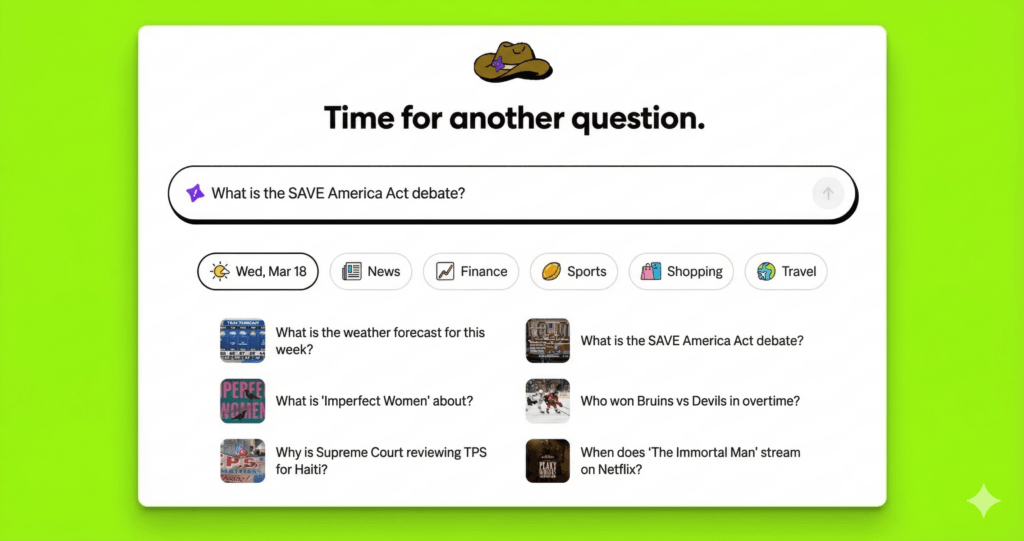
According to The Wall Street Journal, AI-powered tools accounted for 5.6 percent of U.S. desktop search traffic by mid-2025, more than double the year prior. At the same time, research from SEER Interactive shows that more than half of finance-related Google searches now surface AI-generated answers above traditional organic results.
For fintech brands, this means the customer journey often begins and ends inside an AI interface. Websites, blog content, and even strong Google rankings are increasingly bypassed. If a company is not cited in AI responses, it is absent at the exact moment trust is established.
What the AI Visibility Data Reveals
Over the past year, my team at Avenue Z analyzed how fintech brands surface, or fail to surface, inside AI-powered environments. Using our proprietary AI Visibility Index, we tracked more than 1,000 companies across payments, neobanking, crypto, and blockchain.
The results were stark.
Ten fintech brands controlled more than 75 percent of the AI share of voice across ChatGPT, Perplexity, and Gemini. Stripe led with a visibility score of 77 percent, followed by PayPal at 64 percent and Square at 50 percent. These brands appeared repeatedly across prompts, platforms, and use cases.
Most fintechs showed up nowhere at all.
Roughly two-thirds of the payment processors analyzed had zero presence in AI-generated answers. The issue was not product quality. It was the absence of usable signals. No structured content. No authoritative citations. No consistent visibility.
This dominance did not happen by chance. It was engineered.
Why AI Rewards Authority, Not Innovation Alone
AI platforms do not evaluate brands the way people do. They synthesize information based on credibility, structure, and repeat validation across trusted sources. In practice, AI visibility is driven by three core factors.
PR has become a technical asset
AI systems rely heavily on third-party citations, but not all media carries equal weight. Sources like Reuters, NerdWallet, and Investopedia are referenced far more frequently than traditional business press. Brands that appear consistently in these outlets build algorithmic authority. Prestige alone does not translate into visibility. Reference value does.
Technical optimization is required
Highly visible fintech brands tend to operate fast, mobile-first websites with clean architecture. Schema markup, internal linking, entity clarity, and crawlability all influence whether AI systems can read and reuse content. AI cannot recommend what it cannot understand.
Content must mirror real questions
People no longer search keywords. They ask full questions. Content must be structured around intent, using clear explanations, comparisons, FAQs, and conversational formats that reflect how users actually think and speak.
Together, these elements form a modern AI Optimization strategy that extends beyond traditional PR or SEO. The goal is to ensure brands are discoverable, citable, and trusted by both humans and machines.
Smaller Fintechs Can Still Win
AI visibility is not reserved for incumbents.
Growth-stage fintechs like Helcim and Stax ranked higher than many enterprise competitors because they appeared consistently in niche, high-intent queries such as “lowest credit card processing fees” or “transparent payment platforms for SMBs.” Their messaging was focused, their content structured, and their positioning aligned with specific customer pain points.
Chime offers a similar lesson. It appears repeatedly in AI responses tied to no-fee banking and early direct deposit because its messaging remains consistent across earned and owned channels.
AI does not reward size. It rewards clarity and repetition.
Why Most PR Still Fails in AI Search
One of the biggest blind spots for fintech CMOs is misunderstanding how media influences AI visibility.
Reach does not equal relevance.
Our research shows that Reuters is cited nearly twice as often as The Wall Street Journal across major AI platforms. NerdWallet, despite publishing fewer stories, was the most cited source in Perplexity.
AI favors evergreen insight over breaking news, and structured information over narrative spectacle. This requires fintech brands to rethink how they pitch stories, write commentary, and distribute thought leadership. If AI cannot extract and reuse the insight, the coverage delivers little long-term value.
What Fintech Leaders Must Do Now
This is already costing brands growth.
Fintech executives, especially CMOs and Heads of Communications, should begin by auditing their AI visibility. Ask AI platforms the same questions customers ask. Are you in the answers? If not, why?
Then look inward:
Is your content written for real users or legacy algorithms?
Are you cited by sources AI consistently trusts?
Is your site optimized for AI crawlability and reuse?
AI visibility remains open terrain. Brands investing now are building an advantage that compounds over time. Others are quietly disappearing from the conversation.
Innovation alone is no longer enough. If a brand cannot be found, it cannot be chosen.
Read the full article: The Cost of Fintech’s Communication Gap
Discover how Avenue Z helps fintech leaders win AI search with AI Optimization (AIO) here.
Optimize Your Brand’s Visibility in AI Search
Millions turn to AI platforms daily to discover and decide. Make sure they find your brand.